
10 Highly Dangerous Consequences to Malaysia from the US-Malaysia Agreement of Reciprocal Trade That Has Not Been Highlighted by Any Parties
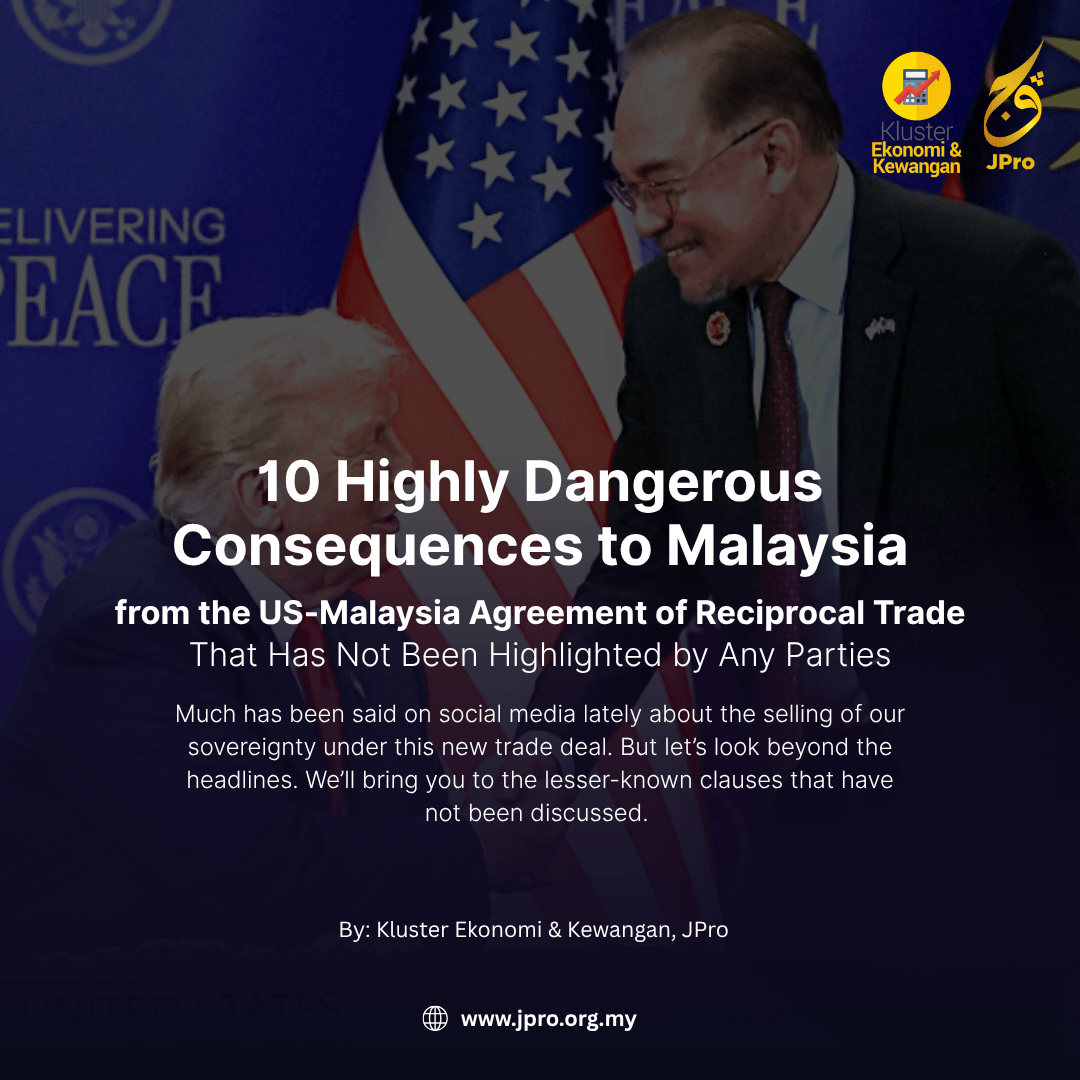
Much has been said on social media lately about the selling of our sovereignty under this new trade deal. But let’s look beyond the headlines. I’ll bring you to the lesser-known clauses that have not been discussed.
These are the clauses that carry deeper consequences, quietly reshaping our economy, industries, and national direction for decades to come:
1. Malaysia could become a major E-waste dumping ground for the U.S.
Article 2.26 – A More Resource Efficient Economy
Data showed that over 70% of U.S. E-waste is illegally exported to Malaysia, making us the most favoured “dumping ground” for major U.S. electronic waste recyclers. This clause encourages Malaysia to recover critical minerals from domestic waste streams (including imported waste) by establishing regulations, infrastructure, or technologies to expand the collection of electronic waste. Under this, U.S. E-waste and batteries could “legally” be shipped here for recycling, turning Malaysia into a dumping ground under the banner of sustainability.
2. Contradiction to our Halal Master Plan 2030.
Article 2.5(1) – Halal Certification for Industrial Goods
The agreement removes halal certification requirements for industrial goods like cosmetics and pharmaceuticals, which are the core sectors of the Malaysian halal market. This undermines Malaysia’s leadership in the halal economy and weakens JAKIM’s long-established global credibility.
3. Technology procurement tied to U.S. interests.
Article 5.2 – Equipment and Platform Security
Malaysia must only use suppliers that meet U.S.-defined “security standards,” effectively giving Washington power to block more advanced providers like Huawei or other non-U.S. tech players. This very much compromises our digital sovereignty.
4. Flooding of U.S. cars, especially used cars into our market.
Article 1.1 – Excise Duties & Article 2.1 – Motor Vehicles and Parts
Malaysia shall apply the lowest excise duty to U.S. cars regardless the engine size, to not cap the total number of U.S. vehicles that can be imported each year (used cars currently capped by AP), and must recognise U.S. safety/emission standards without local approval, and must recognise U.S. safety/emission standards without local approval. This opens the door to the dumping of used U.S. cars, threatening the protection of local manufacturers and our control over market saturation.
5. De-dollarisation efforts down the drain.
Currency Cooperation Clause (Annex)
The U.S. Treasury and Bank Negara Malaysia will “coordinate on currency policy.” This locks Malaysia back into a U.S.-centric system and limits our freedom to diversify reserves or trade in alternative currencies.
6. Strategic national assets at risk.
Article 6.1(1) – Investment & Article 5.2(3) – Investment Security
These clauses prioritise U.S. participation in critical sectors — energy, infrastructure, telecoms, and infrastructures — opening the door to foreign dominance in strategic assets previously reserved for national control.
7. Malaysia to invest nearly RM300 billion in the U.S., not at home.
Article 6.1(3) – Investment
Malaysia must facilitate roughly RM300 billion in the U.S., creating job opportunities there. That is a capital that could have powered domestic development and employment instead.
8. Dismantling Bumiputera agenda.
Article 6.2 – Commercial Considerations
The clause bans “non-commercial assistance” or subsidizing to GLCs/GLICs, effectively disallowing targeted programmes or preferential procurement benefiting Bumiputera or local entrepreneurs under the New Economic Policy.
9. Flood of U.S. goods undermining local players and jobs.
Article 1.2 – Quantitative Restrictions
Malaysia cannot impose quantity limits or protective tariffs on U.S. imports. This risks an oversupply of U.S. goods that would potentially displace local SMEs and manufacturing.
10. Food security and agricultural independence under pressure.
Article 2.6 – Recognition of U.S. Food and Agricultural Control Systems
Malaysia cannot import food from countries that do not meet U.S. standards, such as rice from India and other important agricultural products from other countries. This may reduce our ability to diversify food sources and directly affecting our food security agenda.
When viewed together, these are not just “trade” clauses. They actually reshape our economic sovereignty, social policy, and industrial direction.
So the question we must all ask is:
Does it worth trading our independence away vs what Malaysia truly gains in return?
Prepared by
Kluster Ekonomi & Kewangan,
Jabatan Profesional Muda (JPro)
1 November 2025