
Calling for Transparency and Shared Accountability on the Putra Heights Gas Pipeline Explosion
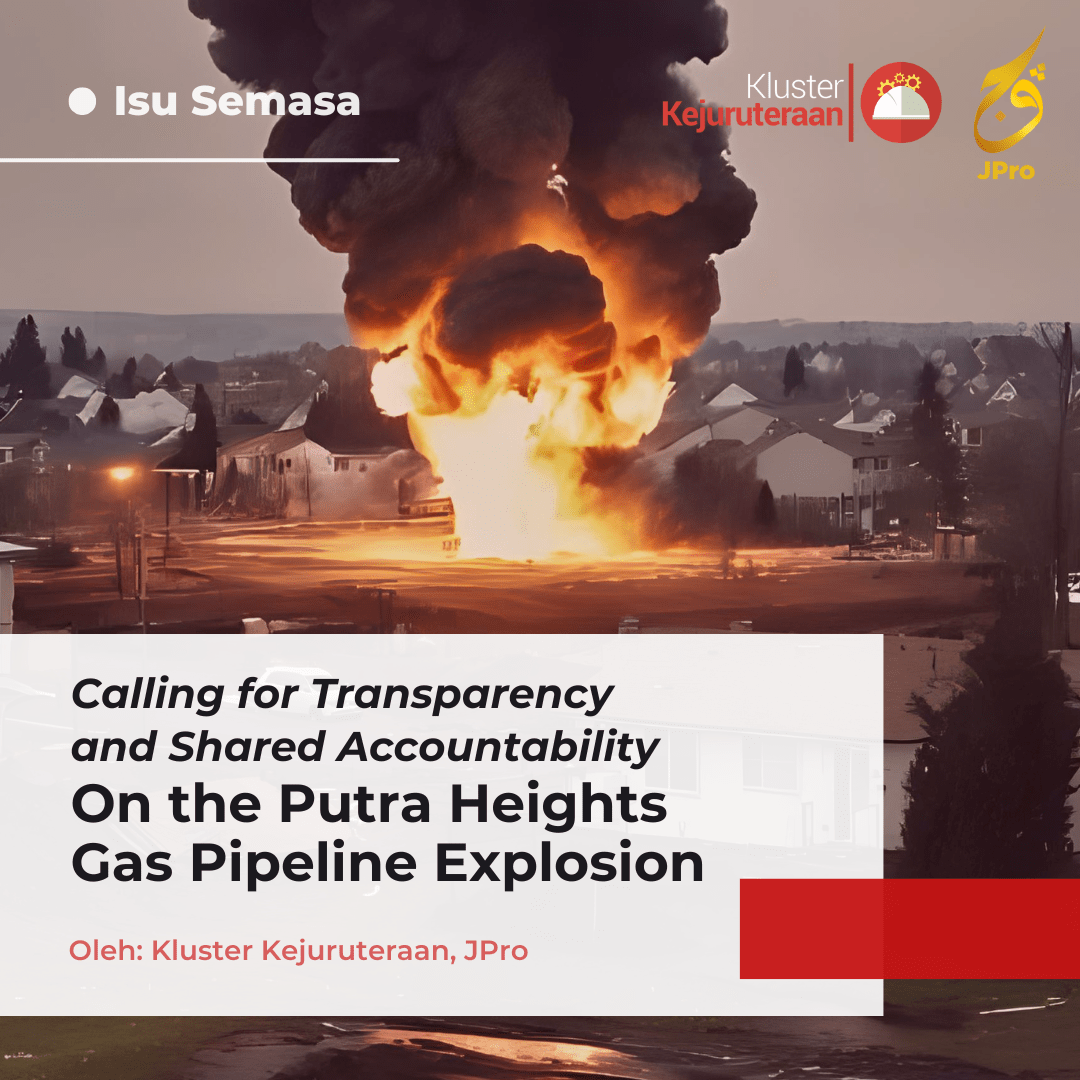
We refer to the public statements issued by the Department of Occupational Safety and Health (DOSH), the Selangor State Government, and former Minister Yeo Bee Yin concerning the tragic gas pipeline explosion at Putra Heights on 1 April 2025. While we commend the efforts of the investigation team, we are compelled to respond with a technical and fact-based perspective. Some of the conclusions reached appear premature and do not comprehensively reflect the full scope of available evidence.
1. Reassessing the Claim of “No Negligence”
The official report concluded that there was no element of sabotage or negligence involved. However, the same investigation acknowledged:
* Damaged culvert and monsoon drain structures crossing the pipeline Right-of-Way (ROW), and
* Evidence of anthropogenic activities that altered the original topography.
These are not minor details — they point to possible contributory factors related to human activity and infrastructure development. It is therefore misleading to dismiss operational accountability outright.
2. Evidence of Excavation Works Near the Incident Site
Multiple credible news sources confirm:
* Excavation and sewer works were conducted just 30 meters from the pipeline, stopping only 48 hours before the explosion occurred (CNA).
* 56 individuals were interviewed in relation to these works, including developers and contractors.
From an engineering standpoint, any ground disturbance — especially in an area with known long-term soil settlement — can intensify stress loading on underground pipelines and should be thoroughly investigated.
3. Eyewitness Accounts Cannot Be Ignored
A total of 179 witness statements were recorded by law enforcement. Residents described the explosion as sounding like a “jet engine” or resembling a minor earthquake — suggesting a sudden and violent structural failure. Given the magnitude of the event, it is reasonable to question whether early warning signs could have been detected and mitigated through enhanced monitoring systems.
4. Pipeline Integrity and Risk Management
It is acknowledged that the pipeline in question complied with API 5L X70 specifications, and no material or weld defects were identified.
However, as the asset owner, the operator remains responsible for long-term structural surveillance and environmental risk assessment. The pipeline segment had operated for over 25 years, and investigations confirmed 15.9 cm of displacement due to soil settlement. These figures are significant from an engineering risk management perspective.
This incident should not be interpreted as a technical failure by the asset owner, but rather a signal that holistic, cross-agency risk management — including urban development coordination, stormwater control, and real-time geotechnical monitoring — must be enhanced.
5. Recommendations and Way Forward
As a public representative and professional engineer, we recommend:
* Full disclosure of all construction and excavation activity within a 100-meter radius of the ROW in the 6 months prior to the incident;
* An independent geotechnical review to assess subsurface instability and evaluate structural support conditions;
* Immediate reassessment and upgrade of pipeline monitoring systems, including strain gauges, deformation tracking, and real-time SCADA alerts in high-risk zones;
* The establishment of a National Underground Infrastructure Risk Management Master Plan, led by a cross-ministerial technical task force.
Conclusion
We urge all parties — including regulators, infrastructure owners, and local authorities — to revisit the existing approach to underground asset safety. We cannot continue to attribute such failures to “soft soil” or “climate factors” alone, especially when such risks have been present and predictable over time.
A proactive, preventive, and transparent culture must guide our infrastructure governance if we are to prevent future tragedies of this nature.
Prepared by
Kluster Kejuruteraan,
Jabatan Profesional Muda (JPro)
1 Julai 2025